

Lyng V Northwest Indian Cemetery
| Six Rivers National Forest | |
|---|---|
 | |
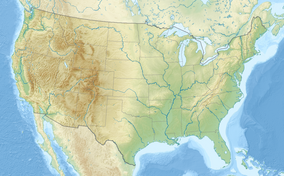
| Map of the United States | |
| Location | Northwest California, US |
| Nearest city | Crescent Urban center, California |
| Coordinates | 41°46′40″N 124°01′00″W / 41.77778°N 124.01667°Due west / 41.77778; -124.01667 Coordinates: 41°46′xl″North 124°01′00″Due west / 41.77778°Due north 124.01667°West / 41.77778; -124.01667 |
| Area | 957,590 acres (3,875.2 km2) |
| Established | 1947 |
| Governing body | U.S. Forest Service |
| Website | Half dozen Rivers National Forest |

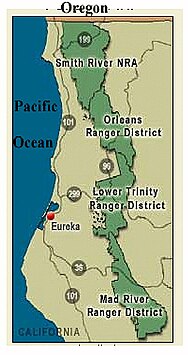
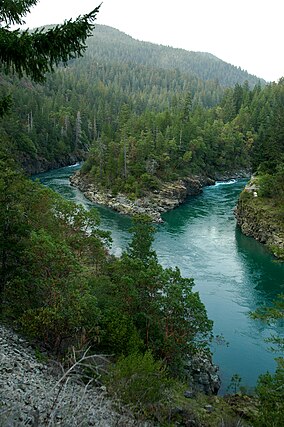
The Six Rivers National Forest is a U.S. National Forest located in the northwestern corner of California. It was established on June iii, 1947 past U.S. President Harry S. Truman from portions of Klamath, Siskiyou and Trinity National Forests. Its over one million acres (4,000 kmii) of state contain a diverseness of ecosystems and 137,000 acres (550 km2) of old growth forest.[1] Information technology lies in parts of four counties; in descending guild of forestland area they are Del Norte, Humboldt, Trinity, and Siskiyou counties. The forest is named after the Eel, Van Duzen, Klamath, Trinity, Mad, and Smith rivers, which pass through or near the forest's boundaries.
The forest has 366 miles (589 km) of wild and scenic rivers, six distinct botanical areas, and public-use areas for camping, hiking, and fishing. The northernmost section of the forest is known equally the Smith River National Recreation Expanse. Forest headquarters are located in Eureka, California. There are local ranger district offices in Bridgeville, Gasquet, Orleans, and Willow Creek.[2]
Its erstwhile-growth forests include Coast Douglas-fir (Pseudotsuga menziesii var. menziesii), Tanoak (Notholithocarpus densiflorus), Pacific madrone (Arbutus menziesii), and White Fir (Abies concolor).[1]
Wilderness areas [edit]
In that location are five designated wilderness areas in Six Rivers National Forest that are part of the National Wilderness Preservation System. Two of them prevarication mostly in other National Forests or on Bureau of Land Management state.
- Mount Lassic Wilderness
- North Fork Wilderness
- Siskiyou Wilderness (partly in Klamath NF)
- Trinity Alps Wilderness (mostly in Trinity NF; partly in Shasta NF, Klamath NF, or on BLM land)
- Yolla Bolly-Eye Eel Wilderness (mostly in Mendocino NF; partly in Trinity NF, or BLM land)
Of import events [edit]
- The Patterson-Gimlin film, claimed to exist a recording of a Bigfoot, was filmed in this national wood.
- Klamath Mountains
- Lyng v Northwest Indian Cemetery Protective Association, a 1988 United states Supreme Court decision, concerned state in the forest claimed every bit sacred by several local Native American tribes
- In 1947 Jose Garcia, begetter of a and then present 5-yr-old Jerry Garcia, slipped on a rock while wing angling in the Trinity River and drowned. Jerry claimed to have witnessed this happen, though others familiar with the family assert that he did not.
References [edit]
- ^ a b Warbington, Ralph; Beardsley, Debby (2002), 2002 Estimates of One-time Growth Forests on the 18 National Forests of the Pacific Southwest Region, United states Forest Service, Pacific Southwest Region
- ^ USFS Ranger Districts by State
External links [edit]
-
 Media related to Half dozen Rivers National Forest at Wikimedia Eatables
 - Official website

Lyng V Northwest Indian Cemetery,
Source: https://en.wikipedia.org/wiki/Six_Rivers_National_Forest
Posted by: herringtonalread.blogspot.com
0 Response to "Lyng V Northwest Indian Cemetery"
Post a Comment