

6p Angular Momentum Quantum Number
Quantum Numbers and Electron Configurations
Quantum Numbers
The Bohr model was a 1-dimensional model that used 1 breakthrough number to describe the distribution of electrons in the cantlet. The only information that was important was the size of the orbit, which was described past the n quantum number. Schr�inger'south model allowed the electron to occupy iii-dimensional space. Information technology therefore required three coordinates, or 3 breakthrough numbers, to describe the orbitals in which electrons can be found.
The three coordinates that come from Schr�inger'south moving ridge equations are the main (n), angular (l), and magnetic (m) quantum numbers. These breakthrough numbers describe the size, shape, and orientation in space of the orbitals on an atom.
The main breakthrough number (n) describes the size of the orbital. Orbitals for which due north = 2 are larger than those for which north = one, for example. Because they have opposite electric charges, electrons are attracted to the nucleus of the atom. Energy must therefore exist captivated to excite an electron from an orbital in which the electron is close to the nucleus (n = 1) into an orbital in which information technology is further from the nucleus (n = 2). The master quantum number therefore indirectly describes the energy of an orbital.
The angular quantum number (fifty) describes the shape of the orbital. Orbitals take shapes that are best described as spherical (50 = 0), polar (l = 1), or cloverleaf (fifty = two). They can even take on more than circuitous shapes as the value of the angular breakthrough number becomes larger.
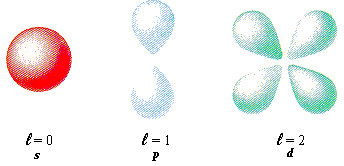
There is only ane fashion in which a sphere (fifty = 0) tin exist oriented in infinite. Orbitals that accept polar (50 = 1) or cloverleaf (l = 2) shapes, nonetheless, tin can point in unlike directions. We therefore need a third quantum number, known equally the magnetic quantum number (m), to describe the orientation in space of a detail orbital. (It is called the magnetic quantum number because the event of unlike orientations of orbitals was starting time observed in the presence of a magnetic field.)

Rules Governing the Allowed Combinations of Breakthrough Numbers
- The 3 quantum numbers (northward, l, and 1000) that describe an orbital are integers: 0, 1, ii, 3, then on.
- The principal quantum number (n) cannot be cipher. The allowed values of northward are therefore one, 2, 3, 4, and and then on.
- The angular quantum number (l) tin exist whatsoever integer between 0 and n - 1. If due north = 3, for example, 50 tin can be either 0, 1, or 2.
- The magnetic quantum number (thou) can be any integer between -l and +l. If l = 2, m can exist either -ii, -1, 0, +1, or +two.
Shells and Subshells of Orbitals
Orbitals that have the same value of the master quantum number form a shell. Orbitals within a shell are divided into subshells that have the aforementioned value of the athwart quantum number. Chemists describe the trounce and subshell in which an orbital belongs with a ii-graphic symbol code such as 2p or 4f. The starting time character indicates the shell (north = two or northward = 4). The 2d character identifies the subshell. Past convention, the post-obit lowercase letters are used to bespeak unlike subshells.
| south: | l = 0 | |
| p: | l = ane | |
| d: | l = 2 | |
| f: | 50 = 3 |
Although at that place is no pattern in the start 4 letters (due south, p, d, f), the letters progress alphabetically from that point (g, h, and then on). Some of the allowed combinations of the northward and l quantum numbers are shown in the effigy below.

The third rule limiting allowed combinations of the north, l, and m quantum numbers has an important issue. Information technology forces the number of subshells in a crush to be equal to the primary quantum number for the beat. The north = three vanquish, for example, contains 3 subshells: the 3s, 3p, and 3d orbitals.
Possible Combinations of Quantum Numbers
There is only one orbital in the n = 1 shell because at that place is only one mode in which a sphere can be oriented in space. The but allowed combination of quantum numbers for which north = ane is the post-obit.
There are four orbitals in the n = 2 shell.
| 2 | 1 | -1 |  | |||
| 2 | one | 0 | 2p | |||
| two | 1 | 1 |
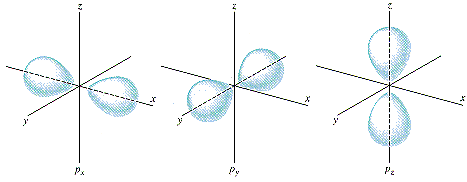
There is only one orbital in the 2south subshell. Merely, in that location are three orbitals in the 2p subshell because there are three directions in which a p orbital can point. One of these orbitals is oriented along the Ten axis, another forth the Y axis, and the third along the Z axis of a coordinate system, as shown in the figure below. These orbitals are therefore known as the twopten , 2py , and 2pz orbitals.
At that place are nine orbitals in the north = 3 shell.
There is ane orbital in the iiis subshell and iii orbitals in the 3p subshell. The northward = 3 shell, yet, also includes threed orbitals.
The five different orientations of orbitals in the threed subshell are shown in the effigy below. One of these orbitals lies in the XY plane of an XYZ coordinate organization and is chosen the threed xy orbital. The 3d xz and 3d yz orbitals take the same shape, merely they prevarication between the axes of the coordinate system in the XZ and YZ planes. The fourth orbital in this subshell lies along the Ten and Y axes and is called the iiidx 2 -y 2 orbital. Most of the space occupied past the fifth orbital lies along the Z axis and this orbital is called the iiidz 2 orbital.
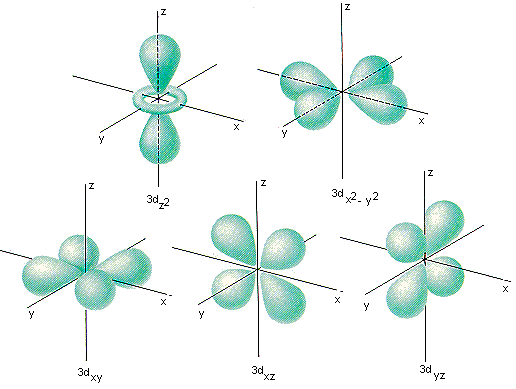
The number of orbitals in a shell is the foursquare of the principal breakthrough number: 12 = i, 22 = 4, iii2 = ix. In that location is one orbital in an s subshell (fifty = 0), three orbitals in a p subshell (l = 1), and 5 orbitals in a d subshell (50 = two). The number of orbitals in a subshell is therefore 2(l) + 1.
Before we can use these orbitals we need to know the number of electrons that can occupy an orbital and how they tin can be distinguished from ane some other. Experimental evidence suggests that an orbital can concord no more than than two electrons.
To distinguish between the two electrons in an orbital, nosotros need a fourth breakthrough number. This is called the spin breakthrough number (south) considering electrons behave every bit if they were spinning in either a clockwise or counterclockwise fashion. One of the electrons in an orbital is arbitrarily assigned an south breakthrough number of +ane/two, the other is assigned an due south quantum number of -one/two. Thus, it takes three breakthrough numbers to define an orbital but iv quantum numbers to identify i of the electrons that tin occupy the orbital.
The allowed combinations of n, fifty, and m quantum numbers for the first four shells are given in the table beneath. For each of these orbitals, there are two allowed values of the spin quantum number, southward.
Summary of Allowed Combinations of Quantum Numbers
| n | l | m | Subshell Notation | Number of Orbitals in the Subshell | Number of Electrons Needed to Make full Subshell | Total Number of Electrons in Subshell | |||||
| 1 | 0 | 0 | 1s | 1 | 2 | 2 | |||||
| 2 | 0 | 0 | 2s | ane | 2 | ||||||
| ii | ane | 1,0,-one | 2p | 3 | 6 | 8 | |||||
| 3 | 0 | 0 | 3s | 1 | 2 | ||||||
| 3 | 1 | 1,0,-1 | 3p | 3 | 6 | ||||||
| 3 | 2 | 2,1,0,-i,-2 | 3d | 5 | 10 | 18 | |||||
| four | 0 | 0 | 4s | 1 | ii | ||||||
| 4 | ane | 1,0,-1 | 4p | three | 6 | ||||||
| four | 2 | two,1,0,-ane,-2 | 4d | 5 | 10 | ||||||
| four | 3 | 3,2,1,0,-1,-ii,-iii | 4f | 7 | xiv | 32 | |||||
The Relative Energies of Atomic Orbitals
Because of the force of attraction between objects of opposite charge, the most important factor influencing the free energy of an orbital is its size and therefore the value of the principal quantum number, n. For an atom that contains only one electron, there is no deviation between the energies of the different subshells inside a shell. The 3s, 3p, and iiid orbitals, for case, have the same energy in a hydrogen cantlet. The Bohr model, which specified the energies of orbits in terms of nothing more than the distance between the electron and the nucleus, therefore works for this atom.
The hydrogen cantlet is unusual, however. As soon as an atom contains more than one electron, the different subshells no longer have the same energy. Inside a given shell, the s orbitals e'er have the lowest free energy. The energy of the subshells gradually becomes larger as the value of the angular quantum number becomes larger.
Relative energies: due south < p < d < f
Equally a result, two factors control the energy of an orbital for near atoms: the size of the orbital and its shape, as shown in the figure beneath.
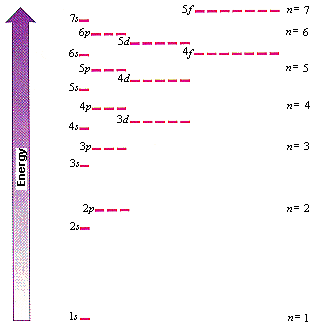
A very simple device can exist synthetic to estimate the relative energies of atomic orbitals. The allowed combinations of the n and l quantum numbers are organized in a table, as shown in the figure below and arrows are drawn at 45 degree angles pointing toward the bottom left corner of the table.
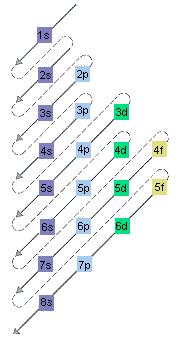
The order of increasing energy of the orbitals is then read off by following these arrows, starting at the acme of the first line and and so proceeding on to the 2d, tertiary, fourth lines, and then on. This diagram predicts the following gild of increasing energy for atomic orbitals.
1southward < 2south < 2p < 3s < iiip <fourdue south < 3d <fourp < vs < ivd < 5p < 6southward < ivf < 5d < vip < 7due south < 5f < 6d < viip < eights ...
Electron Configurations, the Aufbau Principle, Degenerate Orbitals, and Hund'south Dominion
The electron configuration of an atom describes the orbitals occupied past electrons on the atom. The basis of this prediction is a rule known as the aufbau principle, which assumes that electrons are added to an cantlet, 1 at a time, starting with the lowest energy orbital, until all of the electrons have been placed in an advisable orbital.
A hydrogen cantlet (Z = i) has only i electron, which goes into the lowest energy orbital, the 1due south orbital. This is indicated by writing a superscript "one" afterwards the symbol for the orbital.
H (Z = ane): 1s i
The next element has two electrons and the 2nd electron fills the 1due south orbital because there are just 2 possible values for the spin quantum number used to distinguish betwixt the electrons in an orbital.
He (Z = 2): is 2
The third electron goes into the next orbital in the energy diagram, the iis orbital.
Li (Z = 3): 1s 2 2s 1
The fourth electron fills this orbital.
Be (Z = 4): 1s ii iis 2
Afterward the 1s and 2s orbitals have been filled, the adjacent lowest energy orbitals are the three 2p orbitals. The fifth electron therefore goes into one of these orbitals.
B (Z = 5): 1s 2 2south 2 2p 1
When the time comes to add a sixth electron, the electron configuration is obvious.
C (Z = half-dozen): is 2 2southward 2 twop 2
Notwithstanding, there are iii orbitals in the 2p subshell. Does the 2nd electron get into the same orbital every bit the first, or does information technology go into i of the other orbitals in this subshell?
To answer this, nosotros need to empathise the concept of degenerate orbitals. Past definition, orbitals are degenerate when they have the same energy. The energy of an orbital depends on both its size and its shape considering the electron spends more of its time further from the nucleus of the atom as the orbital becomes larger or the shape becomes more complex. In an isolated atom, however, the energy of an orbital doesn't depend on the direction in which it points in space. Orbitals that differ but in their orientation in space, such as the twopx , 2py , and iipz orbitals, are therefore degenerate.
Electrons fill degenerate orbitals according to rules first stated by Friedrich Hund. Hund's rules can be summarized as follows.
- One electron is added to each of the degenerate orbitals in a subshell before two electrons are added to any orbital in the subshell.
- Electrons are added to a subshell with the same value of the spin quantum number until each orbital in the subshell has at least 1 electron.
When the time comes to place two electrons into the twop subshell nosotros put one electron into each of two of these orbitals. (The choice between the 2px , 2py , and 2pz orbitals is purely arbitrary.)
C (Z = 6): 1south two iis 2 twopx 1 iipy 1
The fact that both of the electrons in the 2p subshell have the same spin quantum number tin can be shown past representing an electron for which s = +1/two with an
arrow pointing up and an electron for which s = -1/2 with an arrow pointing down.
The electrons in the 2p orbitals on carbon can therefore be represented as follows.

When we get to Due north (Z = 7), we accept to put one electron into each of the three degenerate twop orbitals.
| N (Z = 7): | 1due south 2 2s ii 2p 3 |  |
Considering each orbital in this subshell now contains one electron, the next electron added to the subshell must have the opposite spin quantum number, thereby filling one of the twop orbitals.
| O (Z = 8): | anesouthward 2 twos 2 iip 4 | 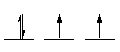 |
The ninth electron fills a second orbital in this subshell.
| F (Z = ix): | 1due south 2 2s 2 2p 5 | 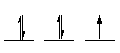 |
The 10th electron completes the 2p subshell.
| Ne (Z = 10): | 1s two 2s ii 2p 6 | 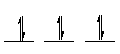 |
In that location is something unusually stable about atoms, such as He and Ne, that take electron configurations with filled shells of orbitals. By convention, we therefore write abbreviated electron configurations in terms of the number of electrons beyond the previous element with a filled-shell electron configuration. Electron configurations of the side by side two elements in the periodic table, for example, could exist written as follows.
Na (Z = eleven): [Ne] threes 1
Mg (Z = 12): [Ne] 3due south 2
The aufbau process tin be used to predict the electron configuration for an chemical element. The actual configuration used by the element has to be determined experimentally. The experimentally determined electron configurations for the elements in the get-go four rows of the periodic table are given in the table in the post-obit section.
The Electron Configurations of the Elements
(1st, 2nd, third, and 4th Row Elements)
| Atomic Number | Symbol | Electron Configuration | ||
| 1 | H | 1s 1 | ||
| ii | He | onedue south 2 = [He] | ||
| iii | Li | [He] twosouthward 1 | ||
| iv | Be | [He] 2s 2 | ||
| 5 | B | [He] 2s two iip 1 | ||
| half-dozen | C | [He] iis 2 twop 2 | ||
| 7 | N | [He] twos ii 2p 3 | ||
| 8 | O | [He] 2s 2 2p 4 | ||
| 9 | F | [He] 2s 2 2p 5 | ||
| 10 | Ne | [He] 2due south ii 2p 6 = [Ne] | ||
| 11 | Na | [Ne] 3s ane | ||
| 12 | Mg | [Ne] threes 2 | ||
| 13 | Al | [Ne] threes 2 threep 1 | ||
| xiv | Si | [Ne] 3s 2 3p 2 | ||
| 15 | P | [Ne] 3s 2 threep three | ||
| 16 | S | [Ne] 3south ii 3p 4 | ||
| 17 | Cl | [Ne] 3s ii 3p 5 | ||
| 18 | Ar | [Ne] 3s ii 3p 6 = [Ar] | ||
| 19 | K | [Ar] 4s 1 | ||
| xx | Ca | [Ar] 4south 2 | ||
| 21 | Sc | [Ar] foursouthward 2 3d 1 | ||
| 22 | Ti | [Ar] 4south 2 3d two | ||
| 23 | V | [Ar] ivs 2 threed iii | ||
| 24 | Cr | [Ar] 4s 1 iiid v | ||
| 25 | Mn | [Ar] 4due south 2 iiid v | ||
| 26 | Fe | [Ar] 4s 2 3d vi | ||
| 27 | Co | [Ar] 4s two 3d 7 | ||
| 28 | Ni | [Ar] ivs 2 3d 8 | ||
| 29 | Cu | [Ar] 4s 1 3d x | ||
| 30 | Zn | [Ar] 4s 2 3d 10 | ||
| 31 | Ga | [Ar] 4s 2 3d ten 4p one | ||
| 32 | Ge | [Ar] 4south 2 3d 10 4p ii | ||
| 33 | As | [Ar] 4s 2 3d 10 ivp 3 | ||
| 34 | Se | [Ar] ivs 2 3d ten 4p four | ||
| 35 | Br | [Ar] fours ii iiid 10 ivp 5 | ||
| 36 | Kr | [Ar] 4s ii 3d ten 4p 6 = [Kr] | ||
Exceptions to Predicted Electron Configurations
There are several patterns in the electron configurations listed in the table in the previous section. I of the most hit is the remarkable level of understanding between these configurations and the configurations we would predict. At that place are only ii exceptions among the start 40 elements: chromium and copper.
Strict adherence to the rules of the aufbau procedure would predict the following electron configurations for chromium and copper.
| predicted electron configurations: | Cr (Z = 24): [Ar] fours 2 3d four | |
| Cu (Z = 29): [Ar] 4due south 2 3d nine |
The experimentally determined electron configurations for these elements are slightly different.
| actual electron configurations: | Cr (Z = 24): [Ar] ivs one 3d v | |
| Cu (Z = 29): [Ar] 4s 1 iiid x |
In each case, i electron has been transferred from the 4s orbital to a 3d orbital, even though the threed orbitals are supposed to be at a higher level than the 4s orbital.
Once we get beyond atomic number 40, the difference between the energies of adjacent orbitals is small plenty that it becomes much easier to transfer an electron from one orbital to another. Most of the exceptions to the electron configuration predicted from the aufbau diagram shown earlier therefore occur among elements with atomic numbers larger than 40. Although it is tempting to focus attending on the handful of elements that have electron configurations that differ from those predicted with the aufbau diagram, the amazing matter is that this simple diagram works for so many elements.
Electron Configurations and the Periodic Tabular array
When electron configuration data are arranged and so that we can compare elements in one of the horizontal rows of the periodic table, we find that these rows typically correspond to the filling of a shell of orbitals. The 2d row, for example, contains elements in which the orbitals in the northward = 2 shell are filled.
| Li (Z = three): | [He] 2s i | |
| Exist (Z = 4): | [He] twosouthward 2 | |
| B (Z = 5): | [He] 2s 2 twop ane | |
| C (Z = 6): | [He] 2s 2 2p two | |
| Due north (Z = 7): | [He] 2due south ii iip iii | |
| O (Z = eight): | [He] iis 2 iip 4 | |
| F (Z = 9): | [He] 2due south two 2p v | |
| Ne (Z = 10): | [He] 2s 2 iip 6 |
There is an obvious pattern within the vertical columns, or groups, of the periodic table as well. The elements in a group have similar configurations for their outermost electrons. This relationship tin be seen by looking at the electron configurations of elements in columns on either side of the periodic table.
| Group IA | Group VIIA | |||||
| H | is 1 | |||||
| Li | [He] 2s 1 | F | [He] 2s 2 twop 5 | |||
| Na | [Ne] 3s 1 | Cl | [Ne] threesouthward 2 3p 5 | |||
| K | [Ar] 4s 1 | Br | [Ar] 4s 2 iiid ten 4p v | |||
| Rb | [Kr] 5due south 1 | I | [Kr] 5southward ii 4d x vp v | |||
| Cs | [Xe] 6due south 1 | At | [Xe] 6s ii 4f fourteen 5d 10 vip 5 |
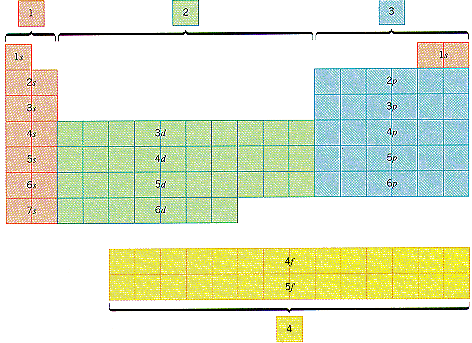
The figure beneath shows the relationship between the periodic table and the orbitals being filled during the aufbau procedure. The two columns on the left side of the periodic table correspond to the filling of an due south orbital. The next x columns include elements in which the five orbitals in a d subshell are filled. The half dozen columns on the right represent the filling of the three orbitals in a p subshell. Finally, the 14 columns at the bottom of the table correspond to the filling of the seven orbitals in an f subshell.

6p Angular Momentum Quantum Number,
Source: https://chemed.chem.purdue.edu/genchem/topicreview/bp/ch6/quantum.php
Posted by: herringtonalread.blogspot.com
0 Response to "6p Angular Momentum Quantum Number"
Post a Comment