

Letter From Birmingham Jail Commonlit
The "Letter from Birmingham Jail", besides known as the "Letter from Birmingham City Jail" and "The Negro Is Your Blood brother", is an open up letter written on Apr 16, 1963, by Martin Luther Rex Jr. It says that people accept a moral responsibleness to pause unjust laws and to have straight activeness rather than waiting potentially forever for justice to come through the courts. Responding to being referred to as an "outsider", King writes: "Injustice anywhere is a threat to justice everywhere."
The letter, written in response to "A Call for Unity" during the 1963 Birmingham campaign, was widely published, and became an important text for the civil rights motion in the United States. The letter of the alphabet has been described as "1 of the virtually important historical documents penned by a modern political prisoner",[one] and is considered a archetype document of civil disobedience.[ii] [three] [4] [5]
Groundwork [edit]
The Birmingham campaign began on April 3, 1963, with coordinated marches and sit-ins against racism and racial segregation in Birmingham, Alabama. The irenic campaign was coordinated by the Alabama Christian Movement for Human Rights (ACMHR) and King'due south Southern Christian Leadership Conference (SCLC). On April x, Circuit Judge W. A. Jenkins Jr. issued a coating injunction against "parading, demonstrating, boycotting, trespassing and picketing." Leaders of the entrada announced they would disobey the ruling.[6] On April 12, Rex was arrested with SCLC activist Ralph Abernathy, ACMHR and SCLC official Fred Shuttlesworth, and other marchers, while thousands of African Americans dressed for Expert Friday looked on.[7]
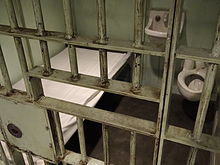
King was met with unusually harsh conditions in the Birmingham jail.[8] An ally smuggled in a paper from April 12, which contained "A Call for Unity", a statement by eight white Alabama clergymen against Male monarch and his methods.[9] The letter provoked King, and he began to write a response to the newspaper itself. Rex writes in Why We Can't Wait: "Begun on the margins of the newspaper in which the statement appeared while I was in jail, the letter was continued on scraps of writing newspaper supplied past a friendly Black trusty, and concluded on a pad my attorneys were eventually permitted to leave me."[10] Walter Reuther, president of the United Auto Workers, bundled $160,000 to bail out King and the other jailed protestors.[11]
Summary and themes [edit]
Male monarch'southward letter of the alphabet, dated April 16, 1963,[x] responded to several criticisms made by the "A Call for Unity" clergymen, who agreed that social injustices existed but argued that the battle confronting racial segregation should be fought solely in the courts, not the streets. He likewise criticizes the merits that African Americans should await patiently while these battles are fought in the courts. As a minister, King responded to the criticisms on religious grounds. As an activist challenging an entrenched social system, he argued on legal, political, and historical grounds. As an African American, he spoke of the country's oppression of Blackness people, including himself. As an orator, he used many persuasive techniques to reach the hearts and minds of his audition. Altogether, Male monarch's letter was a powerful defense of the motivations, tactics, and goals of the Birmingham campaign and the Ceremonious Rights Movement more than generally.
King began the letter of the alphabet by responding to the criticism that he and his beau activists were "outsiders" causing trouble in the streets of Birmingham. King referred to his responsibility as the leader of the SCLC, which had numerous affiliated organizations throughout the South. "I was invited" past our Birmingham affiliate "because injustice is here" in what is probably the most racially-divided metropolis in the land, with its brutal police, unjust courts, and many "unsolved bombings of Negro homes and churches."[12] Referring to his belief that all communities and states were interrelated, Rex wrote, "Injustice anywhere is a threat to justice everywhere. We are caught in an inescapable network of mutuality, tied in a unmarried garment of destiny. Whatever affects one directly, affects all indirectly ... Anyone who lives inside the U.s.a. tin can never be considered an outsider anywhere within its bounds."[xiii] Male monarch also warned that if white people successfully rejected his nonviolent activists as rabble-rousing outside agitators, that could encourage millions of African Americans to "seek solace and security in Blackness nationalist ideologies, a evolution that will lead inevitably to a frightening racial nightmare."[xiv]
The clergymen besides disapproved of tensions created by public actions such as sit-ins and marches. King confirmed that he and his fellow demonstrators were indeed using nonviolent direct action in order to create "effective" tension.[13] The tension was intended to hogtie meaningful negotiation with the white power construction without which true civil rights could never exist accomplished. Citing previous failed negotiations, King wrote that the Black community was left with "no alternative".[13] "Nosotros know through painful experience that freedom is never voluntarily given past the oppressor; it must be demanded by the oppressed."[15]
The clergymen also disapproved of the timing of public actions. In response, King said that recent decisions by the SCLC to filibuster its efforts for tactical reasons showed that it was behaving responsibly. He also referred to the broader scope of history, when "'Wait' has almost always meant 'Never.'"[16] Declaring that African Americans had waited for the God-given and constitutional rights long enough, Male monarch quoted "one of our distinguished jurists" that "justice too long delayed is justice denied."[16] List numerous ongoing injustices toward Black people, including himself, Male monarch said, "Perhaps information technology is easy for those who accept never felt the stinging darts of segregation to say, 'Wait.'"[16] Forth similar lines, King also lamented the "myth concerning time" by which white moderates assumed that progress toward equal rights was inevitable and so assertive activism was unnecessary.[17] King called it a "tragic misconception of time" to assume that its mere passage "volition inevitably cure all ills".[17] Progress takes time as well equally the "tireless efforts" of dedicated people of skilful will.[17]
Confronting the clergymen's exclamation that demonstrations could exist illegal, Rex argued that civil disobedience was not only justified in the face of unjust laws just also was necessary and even patriotic: "The answer lies in the fact that there are ii types of laws: just and unjust. I would be the start to advocate obeying just laws. 1 has not simply a legal but a moral responsibility to obey only laws. Conversely, one has a moral responsibility to disobey unjust laws. I would agree with St. Augustine that 'an unjust constabulary is no police force at all.'" Anticipating the merits that one cannot determine such things, he again cited Christian theologian Thomas Aquinas by saying any law not rooted in "eternal law and natural police" is not merely, while any police force that "uplifts human personality" is only. Segregation undermines homo personality, ergo, is unjust. Furthermore, he wrote: "I submit that an individual who breaks a law that conscience tells him is unjust, and who willingly accepts the penalisation of imprisonment in order to agitate the censor of the customs over its injustice, is in reality expressing the highest respect for law."[xviii]
King cited Martin Buber and Paul Tillich with further examples from the by and present of what makes laws just or unjust: "A law is unjust if information technology is inflicted on a minority that, as a effect of existence denied the right to vote, had no function in enacting or devising the constabulary."[19] In terms of obedience to the law, Rex says citizens have "not merely a legal but a moral responsibility to obey just laws" and also "to disobey unjust laws."[nineteen] Male monarch stated that information technology is not morally wrong to disobey a law that pertains to i grouping of people differently from another. Alabama has used "all sorts of devious methods" to deny its Black citizens their right to vote and thus preserve its unjust laws and broader organisation of white supremacy.[19] Segregation laws are immoral and unjust "considering segregation distorts the soul and damages the personality. Information technology gives the segregator a false sense of superiority and the segregated a faux sense of inferiority."[20] Even some just laws, such as allow requirements for public marches, are unjust when they are used to uphold an unjust system.
King addressed the allegation that the Civil Rights Movement was "farthermost" by starting time disputing the label only so accepting it. Compared to other movements at the time, Male monarch institute himself as a moderate. However, in his devotion to his cause, Rex referred to himself as an extremist. Jesus and other great reformers were extremists: "So the question is non whether we will exist extremists, only what kind of extremists we will be. Will we be extremists for hate or for love?"[21] King's discussion of extremism implicitly responded to numerous "moderate" objections to the ongoing motion, such as US President Dwight D. Eisenhower'due south claim that he could not run into with civil rights leaders considering doing so would crave him to encounter with the Ku Klux Klan.[22]
King expressed general frustration with both white moderates and certain "opposing forces in the Negro community."[23] He wrote that white moderates, including clergymen, posed a claiming comparable to that of white supremacists: "Shallow understanding from people of good will is more frustrating than absolute misunderstanding from people of sick will. Lukewarm credence is much more than bewildering than outright rejection."[24] King asserted that the white church building needed to accept a principled stand or take a chance being "dismissed as an irrelevant social lodge."[25] Regarding the Black community, Male monarch wrote that we need not follow "the 'do-nothingism' of the conceited nor the hatred and despair of the Blackness nationalist."[23]
In the closing, King criticized the clergy'south praise of the Birmingham police for maintaining order nonviolently. The recent public displays of nonviolence past the law were in stark contrast to their typical handling of Black people and, equally public relations, helped "to preserve the evil arrangement of segregation."[25] It is wrong to use immoral means to achieve moral ends but also "to use moral means to preserve immoral ends."[26] Instead of the police, Rex praised the nonviolent demonstrators in Birmingham "for their sublime courage, their willingness to suffer and their amazing field of study in the midst of great provocation. 1 day the South will recognize its existent heroes."[27]
Publication [edit]

King wrote the first function of the letter on the margins of a newspaper, which was the only newspaper available to him. He and so wrote more on bits and pieces of paper given to him past a trusty, which were given to his lawyers to take back to motility headquarters. Pastor Wyatt Tee Walker and his secretary Willie Pearl Mackey so began compiling and editing the literary jigsaw puzzle.[28] He was eventually able to stop the letter of the alphabet on a pad of newspaper his lawyers were immune to get out with him.
An editor at The New York Times Mag, Harvey Shapiro, asked Rex to write his alphabetic character for publication in the magazine, merely the Times chose non to publish it.[29] Extensive excerpts from the letter were published, without King'due south consent, on May 19, 1963, in the New York Post Sunday Mag.[30] The consummate letter was outset published as "Letter from Birmingham City Jail" by the American Friends Service Committee in May 1963[31] [32] and subsequently in the June 1963 issue of Liberation,[33] the June 12, 1963, edition of The Christian Century,[34] and the June 24, 1963, edition of The New Leader. The letter gained more popularity as summer went on, and was reprinted in the July 1963 edition of The Progressive under the headline "Tears of Honey" and the Baronial 1963 edition[35] of The Atlantic Monthly under the headline "The Negro Is Your Blood brother".[36] King included a version of the full text in his 1964 book Why We Can't Look.[a]
The letter was anthologized and reprinted around 50 times in 325 editions of 58 readers. These readers were published for higher-level composition courses between 1964 and 1968.[37]
U.S. Senator Doug Jones (D-Alabama) led an annual bipartisan reading of the letter in the U.S. Senate during his tenure in the U.s.a. Senate in 2019 and 2020,[38] [39] and passed the obligation to lead the reading to Sen. Sherrod Brown (D-Ohio) upon Jones' election defeat.
Notes [edit]
- ^ In a footnote introducing this affiliate of the book, King wrote, "Although the text remains in substance unaltered, I have indulged in the author'southward prerogative of polishing information technology."[x]
References [edit]
Footnotes [edit]
- ^ Greene, Helen Taylor; Gabbidon, Shaun L. (April 14, 2009). "Political Prisoners". Encyclopedia of Race and Criminal offence. SAGE Publications. pp. 636–639. ISBN978-1-4522-6609-1.
- ^ Smith, Robert C. (2003). Encyclopedia of African American Politics. Facts On File. p. 43. ISBN978-i-4381-3019-4.
- ^ Tiefenbrun, Susan (1992). "Semiotics and Martin Luther King's "Letter of the alphabet from Birmingham Jail"". Cardozo Studies in Police and Literature. Taylor & Francis. iv (2): 255–287. doi:10.2307/743322. JSTOR 743322.
- ^ Henretta, James A.; Edwards, Rebecca; Self, Robert O. (January 5, 2011). America'southward History, Combined Volume. Bedford/St. Martin'south. p. 867. ISBN978-0-312-38789-one.
- ^ Christenson, Ron (December 2, 2017). Political Trials: Gordian Knots in the Law. Routledge. ISBN978-1-351-49857-9.
- ^ "Negroes To Defy Ban". The Tuscaloosa News. Vol. 145, no. 101. Apr 11, 1963. p. 21. Retrieved March 2, 2022.
- ^ Rieder 2013, p. 38.
- ^ Rieder 2013, p. 40: "King was placed solitary in a dark cell, with no mattress, and denied a telephone call. Was Connor's aim, as some thought, to suspension him?".
- ^ Rieder 2013, p. 41.
- ^ a b c King 1964, p. 64.
- ^ Shlaes, Amity (March 20, 2020). "The Corking Society: A New History with Amity Shlaes". Hoover Institution. Interviewed by Peter Robinson. Retrieved March ii, 2022.
- ^ Male monarch 1964, pp. 65–66.
- ^ a b c King 1964, p. 65.
- ^ King 1964, p. 76.
- ^ Rex 1964, p. 68.
- ^ a b c Rex 1964, p. 69.
- ^ a b c Rex 1964, p. 74.
- ^ King 1964, p. 72.
- ^ a b c King 1964, p. 71.
- ^ Rex 1964, pp. 70–71.
- ^ Rex 1964, p. 77.
- ^ McCarthy 2010, p. xvi.
- ^ a b King 1964, p. 75.
- ^ King 1964, p. 73.
- ^ a b King 1964, p. 80.
- ^ King 1964, p. 82.
- ^ Male monarch 1964, p. 83.
- ^ Walker, Wyatt (April 20, 1989), Interview with Wyatt Walker, nearly Fred Shuttlesworth, interviewed by Andrew Manis, Caanan Baptist Church, New York City: Transcription held at Birmingham Public Library, Birmingham, Alabama, p. 24 .
- ^ Trick, Margalit (January 7, 2013). "Harvey Shapiro, Poet and Editor, Dies at 88". The New York Times . Retrieved October 12, 2017.
- ^ Bass 2001, p. 140.
- ^ University, © Stanford; Stanford; California 94305 (May 17, 2017). ""Alphabetic character from Birmingham Jail"". The Martin Luther King, Jr., Research and Education Institute . Retrieved May v, 2022.
- ^ "Letter from Birmingham City Jail". American Friends Service Committee. April 16, 2021. Retrieved May 5, 2022.
- ^ King, Martin Luther Jr. (1963). "Letter from Birmingham Jail". Liberation: An Independent Monthly. Vol. 8, no. 4. pp. ten–sixteen, 23. ISSN 0024-189X.
- ^ Reprinted in "Reporting Civil Rights, Part I", (pp. 777–794), American Journalism 1941–1963. The Library of America
- ^ Rex, Martin Luther Jr. (August 1963). "Letter of the alphabet From Birmingham Jail". The Atlantic. ISSN 1072-7825. Retrieved October 15, 2019.
- ^ Rieder 2013, ch. "Gratis at Terminal?".
- ^ Flower 1999.
- ^ "TUESDAY, APRIL 9: Senator Doug Jones to Atomic number 82 Bipartisan Commemorative Reading of Dr. Martin Luther Rex, Jr.'s 1963 Letter from Birmingham Jail", Doug Jones, U.South. Senate, April eight, 2019, archived from the original on Jan xi, 2020
- ^ "VIDEO: Senator Doug Jones Leads 2d Annual Bipartisan Reading of Dr. Martin Luther King, Jr.'s Letter from Birmingham Jail on the Senate Floor", Doug Jones, U.S. Senate, June 16, 2020, archived from the original on October v, 2020
Bibliography [edit]
- Bass, S. Jonathan (2001). Blessed Are the Peacemakers: Martin Luther King, Jr., Eight White Religious Leaders, and the "Letter of the alphabet from Birmingham Jail". Baton Rouge, Louisiana: Louisiana State University Press. ISBN978-0-8071-2655-4.
- Flower, Lynn Z. (1999). "The Essay Canon" (PDF). College English. 61 (4): 401–430. doi:x.2307/378920. ISSN 0010-0994. JSTOR 378920. Archived from the original (PDF) on Dec 22, 2015. Retrieved January 18, 2012.
- Fulkerson, Richard P. (1979). "The Public Letter every bit a Rhetorical Form: Structure, Logic, and Style in King's 'Letter from Birmingham Jail'". Quarterly Periodical of Oral communication. 65 (ii): 121–136. doi:x.1080/00335637909383465.
- Gilbreath, Edward (2013). Birmingham Revolution: Martin Luther Male monarch Jr.'southward Epic Challenge to the Church. Downers Grove, Illinois: InterVarsity Press. ISBN978-0-8308-3769-four.
- King, Martin Luther, Jr. (1964). Why We Can't Await. New York: Signet Classic (published 2000). ISBN978-0-451-52753-0.
- McCarthy, Anna (2010). The Citizen Machine: Governing by Boob tube in 1950s America. New York: The New Press. ISBN978-1-59558-498-4.
- Oppenheimer, David Benjamin (1993). "Martin Luther King, Walker v. City of Birmingham, and the Letter from Birmingham Jail" (PDF). U.C. Davis Law Review. 26 (iv): 791–833. ISSN 0197-4564. Retrieved Oct 12, 2017.
- Rieder, Jonathan (2013). Gospel of Freedom: Martin Luther King, Jr.'s 'Letter From Birmingham Jail' . New York: Bloomsbury Press. ISBN978-one-62040-058-6.
- Snowfall, Malinda (1985). "Martin Luther King's 'Letter of the alphabet from Birmingham Jail' equally Pauline Epistle". Quarterly Journal of Speech. 71 (3): 318–334. doi:10.1080/00335638509383739. ISSN 1479-5779.
Further reading [edit]
- Bass, S. Jonathan (2014). "Letter from Birmingham Jail". Encyclopedia of Alabama. Alabama Humanities Foundation. Retrieved Oct 12, 2017.
- Carpenter, C. C. J.; Durick, Joseph Aloysius; Grafman, Milton Fifty.; Hardin, Paul; Harmon, Nolan Bailey; Murray, George M.; Ramage, Edward V.; Stallings, Earl (1963). Public Statement by Viii Alabama Clergymen (PDF) . Retrieved Oct 12, 2017 – via Quia.
- Rex, Martin Luther Jr. (1963). Letter from Birmingham Jail (PDF). Stanford, CA: The Martin Luther King, Jr. Enquiry and Education Institute. Retrieved October 12, 2017.
- "Letter from Birmingham Jail". Bhamwiki. 2017. Retrieved Oct 12, 2017.
{{cite web}}: CS1 maint: url-status (link) - "Martin Luther King, Jr. and Nonviolent Resistance". EDSITEment!. National Endowment for the Humanities. Retrieved October 12, 2017.
{{cite spider web}}: CS1 maint: url-status (link) - Walker v. Birmingham , 388 U.South. 307 (1967).
External links [edit]
- Full text in HTML at the Academy of Pennsylvania
- Full text in PDF at Stanford
- A Reading of the Letter from Birmingham Jail on YouTube, from The Kirwan Institute for the Report of Race and Ethnicity
- Console discussion on "Letter from Birmingham Jail" with Julian Bond, Stephen 50. Carter, Gary Hall, Walter Isaacson, Eric Fifty. Motley, and Natasha Trethewey, February 24, 2014, C-Span

Letter From Birmingham Jail Commonlit,
Source: https://en.wikipedia.org/wiki/Letter_from_Birmingham_Jail
Posted by: herringtonalread.blogspot.com
0 Response to "Letter From Birmingham Jail Commonlit"
Post a Comment